
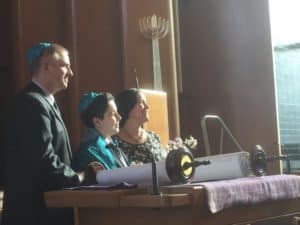
GJC’s goal for the B’nei* Mitzvah experience is that it be as meaningful as possible for our students and families. To this end, our Rabbi, Executive Director, and many others, work with each family to coordinate and prepare for this simcha.
Families with students in 6th grade (both Day School and Religious School!) participate in the B’nei Mitzvah Mehinah (preparation) Program, (a.k.a., “Mechinah”.) Mechinah involves both parents and students and spans the entire year. While we know that each child and family is unique, we’ve found that going through these basic steps together – with other children and families – leads to a meaningful event that you can enjoy together.
Mechinah consists of four components:
1: Student Study
- Mechinah Shabbat: Students gather together 10-12 times on Shabbat mornings in the fall and spring to deepen their relationships with one another and to the GJC prayer communities. We also spend time practicing the prayers that they will lead during their B’nei Mitzvah service so they learn them and are more comfortable leading them when the time comes.
- Individual Tutoring: GJC has hired a B’nei Mitzvah tutor to teach all the students in the Mechinah program their specific Torah and haftarah portions. Starting 8-10 months before their B’nei Mitzvah date, the tutor will meet regularly with your child in weekly sessions of 30-60 minutes for a total of 10 hours per student. Should additional tutoring be required, parents will need to set that up privately.
2: Family Gatherings
- Sunday Mornings: Several times during the year, parents and students will engage in learning together to explore the deeper meanings of this ancient ritual for your family. The sessions are led by our Rabbi with occasional help from others. One Sunday is reserved for the class to engage in the mitzvah of feeding the hungry by packing and delivering food to elderly people with the Jewish Relief Agency.
- Havdallah potluck: We will gather in the winter to eat, enjoy and compare notes on how it’s going!
- Friday Night Service and Dinner Siyyum (“conclusion”): 6th grade families celebrate the conclusion of the Mechianah experience and the start of their B’nei Mitzvah season by attending a GJC Friday night service together and then gathering for Shabbat dinner, games, singing and fun!
3: Taking on a Mitzvah
One way to infuse the B’nei Mitzvah process with greater meaning is for students and families to explore the meaning of mitzvot/”commandments” in their lives. To do this, each student (with support from GJC and their family) is invited to commit to exploring one or more mitzvot in a way that is rooted in their unique set of skills and interests. Approximately eight months before your child’s B’nei Mitzvah, you will meet with the Youth and Families staff to begin the process of choosing and planning the mitzvah project. The goal is for the experience to be completed before the B’nei Mitzvah service so that the child can choose to reflect on the work they did and inspire the community as part of the ritual.
4: Meetings with the Rabbis
The GJC rabbis view B’nei Mitzvah as a special time to connect with each family and child, and enjoy being actively involved in the process. At minimum, one of the rabbis will meet with the family six times in the year before the B’nei Mitzvah to outline the process, help the student with their d’var Torah and rehearse for the big day..
For more information on B’nei Mitzvah at GJC, see: 2025-26 B’nei Mitzvah Handbook
*A note about “b’nei mitzvah” language & gender: Hebrew is a gendered language and as such, words in Hebrew are either gendered male or female. We know that for some people, including our emerging Jewish teens, who identify as part of a wider spectrum of gender, this binary language of male or female/ Bar or Bat Mitzvah doesn’t fit. At GJC we use the term B’nei Mitzvah (Hebrew plural – but, for some, also a possibility for a singular gender-neutral form parallel to the pronouns they/ them/ theirs) in an effort to ensure that all are seen, and all feel represented both by our language and in this important coming of age milestone in Jewish tradition.